



The Federal Government of Nigeria has announced far-reaching reforms designed to eradicate examination malpractice in the West African Examinations Council (WAEC) and the National Examinations Council (NECO), beginning from the 2026 examination cycle.
The new measures were unveiled by the Minister of Education, Dr. Maruf Tunji Alausa, alongside the Minister of State for Education, Professor Suwaiba Said Ahmed. According to the ministers, the reforms are aimed at restoring integrity, credibility, and public confidence in Nigeria’s secondary school examination system.
A major highlight of the policy is the introduction of enhanced question randomization and serialization. Under this system, candidates will answer the same examination questions, but the sequence and arrangement will differ for each student, making collusion and copying extremely difficult. This approach mirrors global best practices in assessment security.
In addition, the government will introduce a unique Examination Learners’ Identity Number (ELIN) for every candidate. The ELIN will serve as a permanent identifier throughout a student’s examination journey, strengthening tracking and accountability across WAEC, NECO, and the National Business and Technical Examinations Board (NABTEB).
Another key reform is a strict no-transfer policy for final-year secondary school students. This measure is intended to block loopholes often exploited for exam fraud through late-stage school transfers. Authorities believe the policy will significantly reduce impersonation and other forms of malpractice.
The reforms also extend to continuous assessment procedures. Henceforth, submissions will be conducted within fixed, nationwide time windows, supported by tighter monitoring and supervision. Examination bodies will collaborate more closely to ensure uniform standards and enforcement across the country.

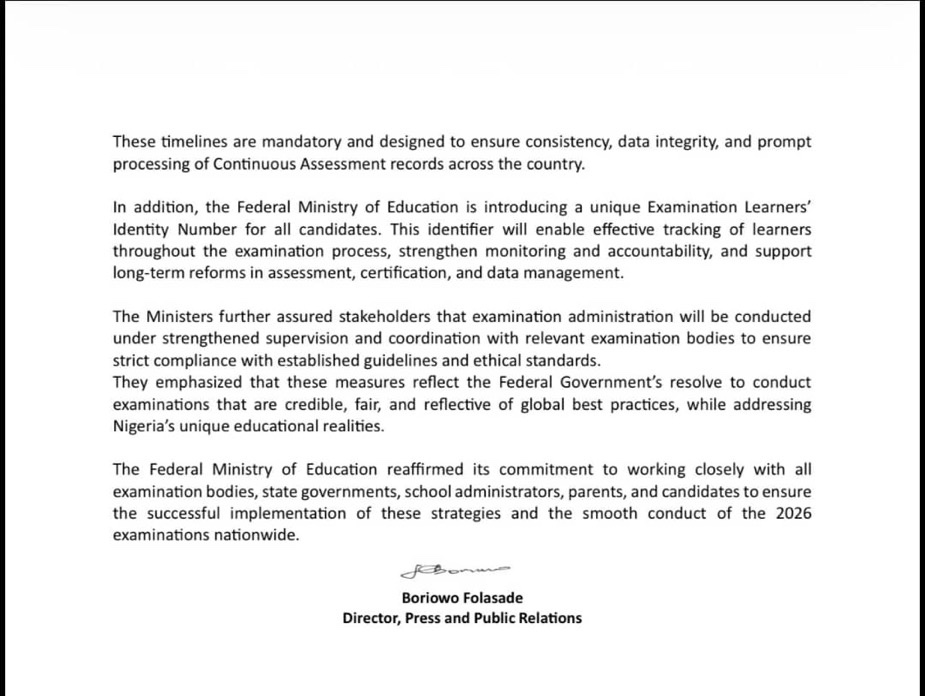
Education officials say the new strategy builds on the relative success of the Joint Admissions and Matriculation Board’s (JAMB) computer-based testing system, which has helped reduce large-scale cheating in tertiary admissions. Stakeholders have welcomed the announcement while urging full, transparent implementation and broader reforms to address underlying challenges in the education sector.
ALSO READ: Nigeria to Enforce 10% Tax on Foreign Currency Deposit Interest from 2026
With these measures, the Federal Government aims to safeguard the value of Nigerian certificates and ensure that academic success is earned through merit rather than malpractice.