


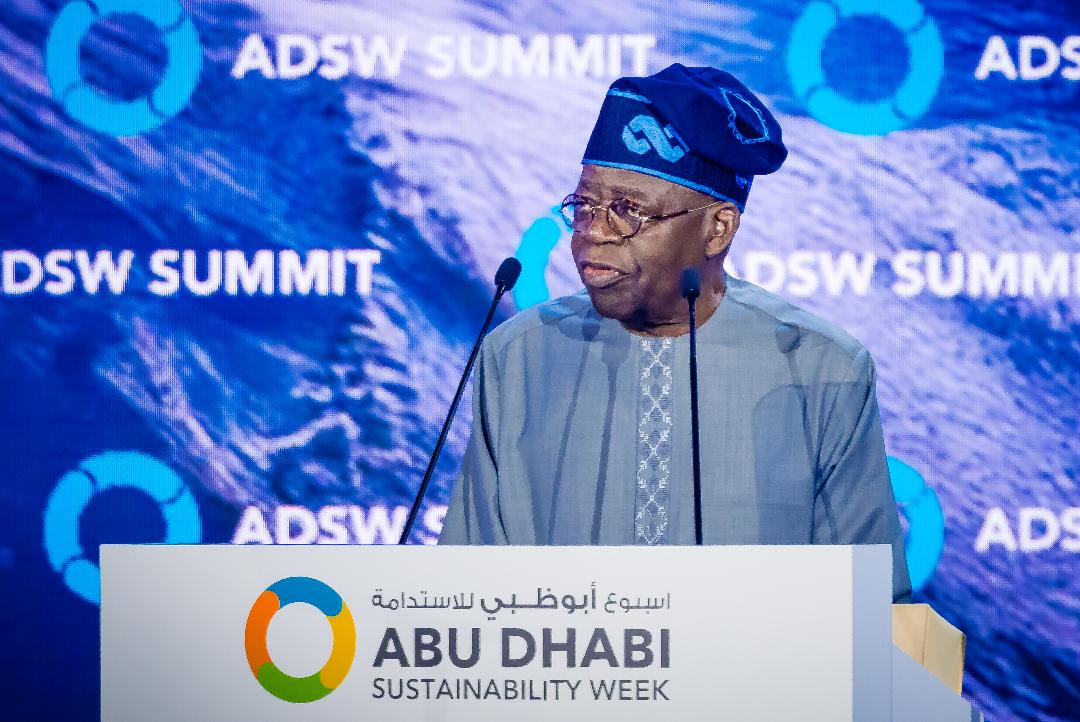
Nigeria has taken a major step toward strengthening its global investment profile as President Bola Ahmed Tinubu announced that the country will co-host Investopia with the United Arab Emirates in Lagos this February. The high-level investment forum is designed to attract international investors, encourage innovation, and drive sustainable economic growth across Nigeria and Africa.
The announcement was made during the 2026 Abu Dhabi Sustainability Week, a global platform focused on climate action and sustainable development. On the sidelines of the event, Nigeria and the UAE also signed a Comprehensive Economic Partnership Agreement, marking a significant milestone in bilateral relations. The agreement is expected to deepen cooperation in key sectors such as renewable energy, infrastructure, aviation, agriculture, logistics, and digital trade.
President Tinubu described the partnership as a strategic and historic agreement that will unlock long-term opportunities for citizens of both countries. He emphasized that Investopia will serve as a bridge between ideas and action by bringing together investors, policymakers, innovators, and business leaders from around the world.
According to the President, Nigeria is positioning itself as a leading destination for sustainable investment, with plans to mobilize up to 30 billion dollars annually in climate and green industrial finance. He highlighted electricity as the backbone of modern economies and stressed Nigeria’s commitment to balancing industrial growth with environmental responsibility as it advances its energy transition agenda.
President Tinubu also called for reforms in the global financial system, urging a move away from strict sovereign guarantee requirements that often limit access to finance for developing economies. Instead, he advocated for blended finance models and first-loss capital structures that allow private investment to flow into green projects without overburdening national finances.
To boost investor confidence, Nigeria has strengthened its climate governance framework through the adoption of a National Carbon Market Activation Policy and the launch of a National Carbon Registry. These initiatives aim to improve transparency, accountability, and participation in global carbon markets.
Energy sector reforms remain central to Nigeria’s development strategy. The President pointed to the Electricity Act 2023 as a key driver of decentralised power generation, particularly for underserved communities. He also highlighted a 500 million dollar distributed renewable energy fund backed by the Nigeria Sovereign Investment Authority, alongside a 750 million dollar World Bank-supported programme expected to expand clean electricity access to more than 17.5 million Nigerians.
Reaffirming Nigeria’s commitment to achieving net-zero emissions by 2060, President Tinubu stressed that economic growth and universal energy access remain top priorities under the country’s Energy Transition Plan. He also invited foreign investors to explore opportunities in Nigeria’s lithium and critical minerals sector, noting that the government prioritizes local processing and value addition.
ALSO READ: APC Digital Registration Surges as Party Targets Over 9 Million Members in Two Weeks
The President concluded by noting that ongoing economic reforms are yielding positive results, including a 21 percent increase in non-oil exports and a rise in capital inflows. With more than 50 billion dollars in investment commitments across strategic sectors, Nigeria is positioning itself for a future that is green, inclusive, and sustainable.