


President Bola Ahmed Tinubu has announced sweeping reforms to Nigeria’s sports funding system following the country’s remarkable medal success in 2025, a year many now describe as a golden chapter in Nigerian sports history.
Speaking on Friday, the President directed all relevant ministries and agencies to ensure the immediate release of sports-related funds beginning from the 2026 fiscal year. Under the new framework, sports financing will be streamlined into a unified structure managed by the National Sports Commission (NSC), a move aimed at eliminating long-standing bureaucratic delays that have hindered athlete preparation and participation.
The announcement comes on the back of Nigeria’s outstanding performances in 2025, including the Super Eagles’ bronze medal finish at the Africa Cup of Nations, dominant outings by the women’s football and basketball teams, and the emergence of a Nigerian wrestler as world number one.
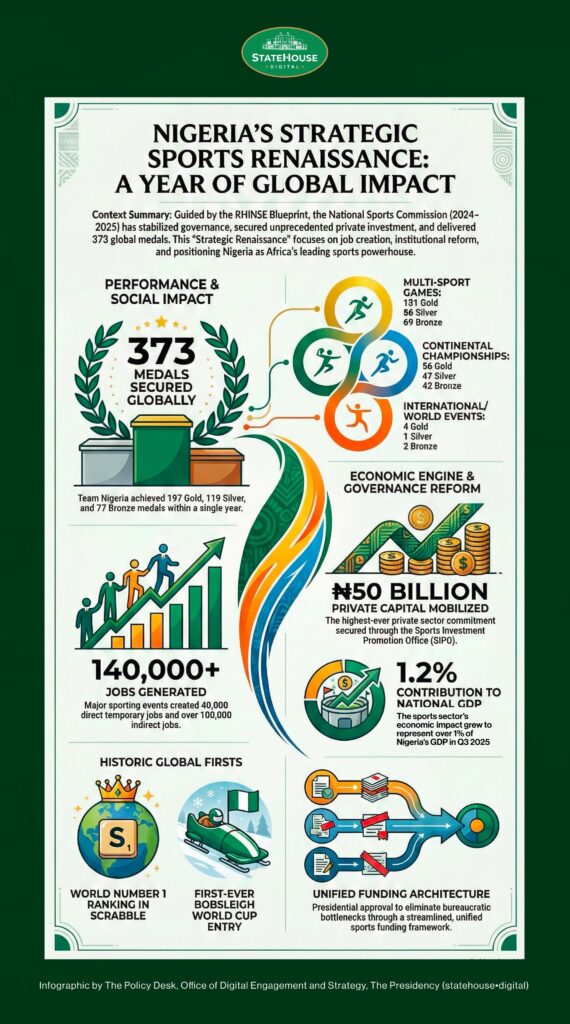
Across all sports, Nigerian athletes collectively secured an unprecedented 373 medals, reinforcing the nation’s reputation as a global sporting powerhouse.
According to President Tinubu, sports remains one of Nigeria’s strongest national brands. Beyond medals, it unites citizens across ethnic, religious, and social divides, inspires national pride, and fosters a shared sense of identity. He noted that when talent is matched with proper structure and preparation, Nigerian athletes consistently excel on continental and global stages.
The President praised the National Sports Commission, under the leadership of its Chairman, Malam Shehu Dikko, for driving reforms aligned with his administration’s Renewed Hope Agenda. Despite existing challenges, the NSC has played a key role in resetting and refocusing the sports sector toward long-term growth and shared prosperity.
However, Tinubu acknowledged that persistent issues have held Nigerian sports back. Funding has often been fragmented across multiple institutions, released too late, or insufficient for proper training and competition. He also highlighted the lack of sustained investment in sports infrastructure that meets international standards, a gap that has repeatedly placed Nigerian athletes at a disadvantage.
To address these concerns, the President approved a comprehensive reset of sports financing. From 2026 onward, the national budget will make dedicated annual provisions for sports infrastructure development, maintenance, programs, events, and international competitions.
Crucially, all approved funds will be released immediately once the budget is passed and signed into law, ensuring certainty for athletes and administrators alike.
In addition, allocations for sports activities currently spread across various ministries, departments, and agencies will be reviewed, consolidated, and redirected into a single funding framework under the National Sports Commission. The goal is to strengthen grassroots development, domestic competitions, and Nigeria’s presence at international sporting events.
These reforms are anchored on the Renewed Hope Initiative for Nigeria’s Sports Economy (RHINSE), which positions sports as a catalyst for job creation, tourism, investment, and global influence. Through scientific athlete development, revitalized sports federations, expanded grassroots participation, and the hosting of major international competitions, the administration aims to build a sustainable sports ecosystem.
ALSO READ: History of Money in Nigeria: What Nigerians Used Before the Naira
President Tinubu emphasized that sports, as a national asset, must be managed and funded according to its unique demands, free from administrative bottlenecks. He reaffirmed his commitment to early athlete support, thorough preparation, and proper celebration of sporting excellence.
READ ALSO: National Convention: APC Replaces Uzodimma as Committee Chairman
With these reforms, the President said, the future of Nigerian sports will be deliberate, well-funded, and globally competitive and Nigeria will continue to win with pride.