


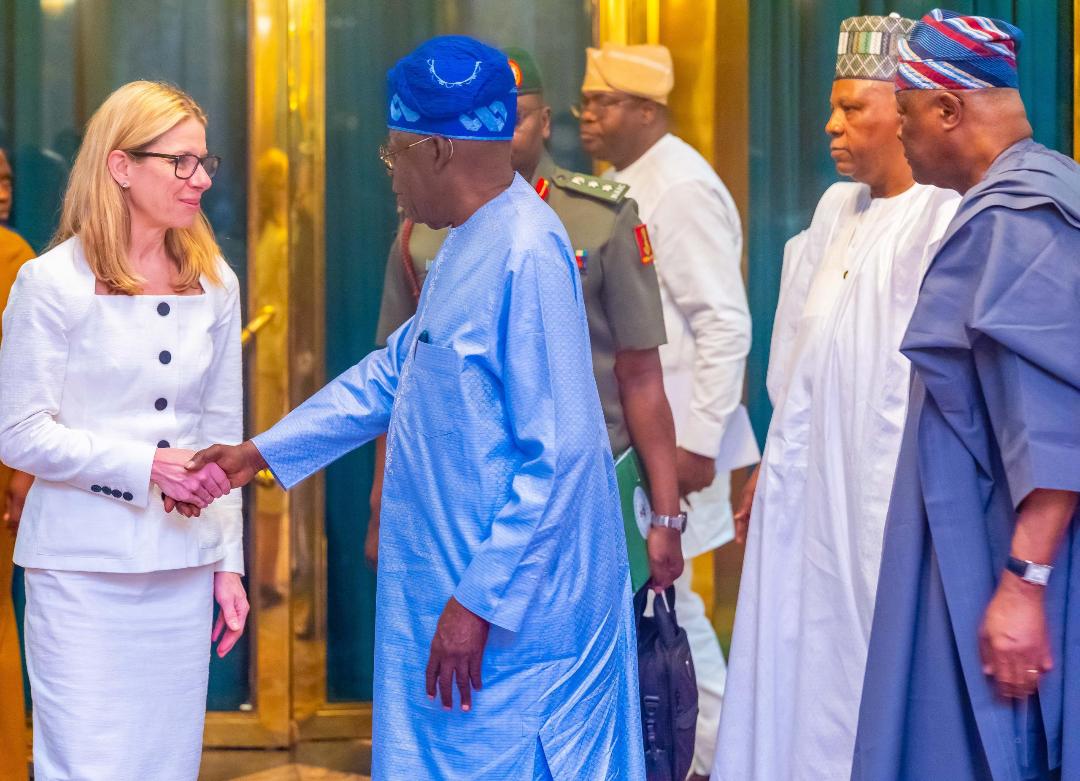
The World Bank has described Nigeria as a growing global reference point for steady and credible reform leadership, citing the country’s sustained commitment to economic transformation despite prevailing challenges.
This assessment was made by the World Bank’s Managing Director of Operations, Anna Bjerde, during a meeting with President Bola Ahmed Tinubu and Vice President Kashim Shettima on Tuesday at the State House in Abuja. Bjerde led a delegation of senior World Bank officials to the engagement.
She commended the Nigerian government for maintaining consistency in its reform agenda over the past two years, noting that the administration’s determination to stay the course has begun to yield measurable results. According to her, this approach has strengthened confidence among global investors, policymakers, and private sector stakeholders.
Bjerde revealed that Nigeria is now frequently referenced in international policy discussions as an example of credible and disciplined reform implementation. She also highlighted the upcoming Country Partnership Framework, explaining that it is closely aligned with Nigeria’s development priorities, including the ambitious target of achieving a $1 trillion economy and sustaining a 7 percent growth rate.
President Tinubu, in his remarks, reaffirmed his administration’s commitment to ongoing economic reforms, stressing that despite initial difficulties, there would be no reversal of policy direction. He acknowledged that the removal of fuel subsidies and the unification of foreign exchange rates initially fueled inflationary pressures, but emphasized that inflation has since eased while the naira has stabilized.
The President stated that the reforms are built on transparency, accountability, and policy stability, all of which are essential for restoring investor confidence and improving the ease of doing business.
Agricultural transformation, according to President Tinubu, remains a central focus of his administration. He disclosed that the government has invested in zonal mechanisation centres, improved seed development, and fertilizer supply, supported by growth in the petrochemical industry. These efforts are aimed at increasing productivity and transitioning farmers from subsistence operations to well-structured cooperatives.
Describing Nigeria as the economic heart of Africa, the President stressed the importance of leveraging the nation’s youthful population and vast arable land to drive inclusive growth through modernized agriculture.
He further urged the World Bank to strengthen its partnership with Nigeria by fast-tracking financing, reducing bureaucratic bottlenecks, sharing proven development models, managing risks, and supporting local capacity development.
In response, Bjerde emphasized the need to expand access to finance for small, medium, and large businesses, particularly mid-sized enterprises, which she described as critical drivers of employment and economic expansion.
She also praised Nigeria’s focus on early childhood development, noting that it plays a vital role in improving long-term productivity. Bjerde assured the government of the World Bank’s continued support in this area, pointing out that rising levels of child stunting remain a global concern.
ALSO READ: VIDEO: Makinde Slams Wike, Challenges His Record in Rivers PDP
The World Bank official reaffirmed the institution’s commitment to a partnership framework aligned with Nigeria’s national priorities, combining both public and private sector interventions. She confirmed that the World Bank Group, through the International Development Association (IDA), International Bank for Reconstruction and Development (IBRD), and the International Finance Corporation (IFC), stands ready to support Nigeria’s reform agenda.
Also present at the meeting were the Minister of Finance and Coordinating Minister of the Economy, Wale Edun, and the Deputy Chief of Staff to the President, Ibrahim Hassan Hadejia.