

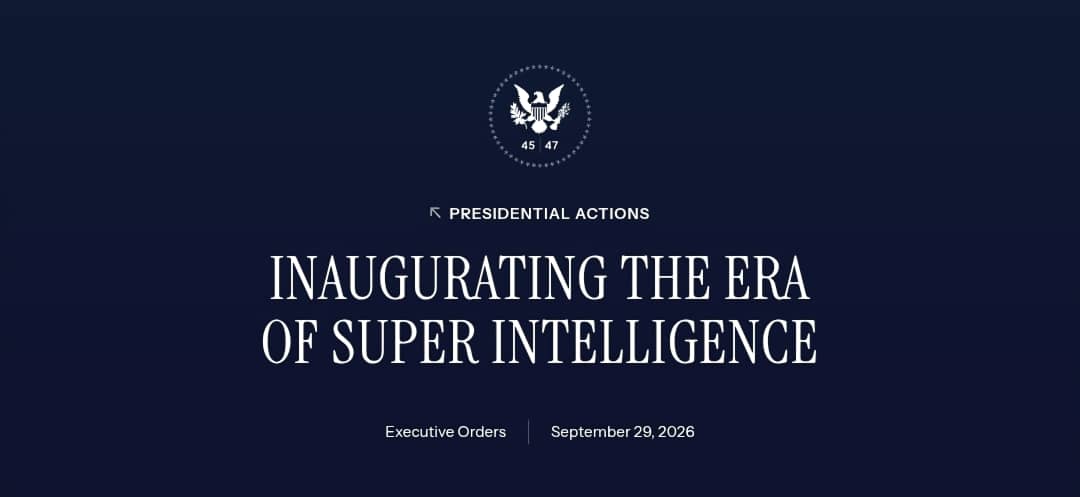
United States President Donald Trump has signed a new Executive Order directing the federal government to replace the terms “Artificial Intelligence” (AI) and “AI” with “Super Intelligence” (SI) and “Super Intelligence” in official executive-branch communications.
The order, titled “Inaugurating the Era of Super Intelligence,” was signed at the White House on September 29, 2026. It presents the terminology change as part of the administration’s broader effort to recognize what it describes as the rapidly expanding capabilities of advanced intelligence technologies.
The White House says the technology has moved beyond earlier concepts of machines simply imitating or automating aspects of human intelligence. According to the administration, modern frontier systems are increasingly being used to amplify human creativity and support advances across areas such as science, medicine, manufacturing and other fields.
Under the Executive Order, federal departments and agencies are directed, to the maximum extent permitted by law, to use “Super Intelligence” and “SI” instead of “Artificial Intelligence” and “AI” in official correspondence, public communications, websites, reports, policy documents and other non-statutory materials.
The order does not, however, require the government to rewrite documents that were issued before the directive. Previously issued regulations, presidential actions, contracts, grants and other historical records are not required to be altered.
Why Trump Is Changing the Terminology
The Executive Order argues that the phrase “Artificial Intelligence” no longer adequately reflects the capabilities of the latest generation of advanced systems.
The White House maintains that the United States played a foundational role in the development of the modern field and remains at the forefront of technological innovation. The administration therefore argues that “Super Intelligence” better reflects what it views as the expanding capabilities and potential of frontier technologies.
The order describes the terminology change as part of a new technological era and directs the executive branch to align its language with the administration’s vision for the development and deployment of advanced intelligence technologies.
What the Executive Order Actually Changes
The directive primarily changes terminology within the executive branch rather than immediately changing every federal law that refers to artificial intelligence.
For purposes of implementing the order, “Super Intelligence” and “SI” are initially tied to the existing statutory definition of artificial intelligence contained in federal law. This means the terminology changes, while the underlying legal framework remains relevant.
The order also instructs the Assistant to the President for Science and Technology to submit proposed legislative language within 60 days.
That proposal is expected to examine whether the definition of “Super Intelligence” should modify, expand or replace the existing statutory definition of artificial intelligence. It is also expected to identify potential amendments to federal laws that currently use the terms “Artificial Intelligence” or “AI.”
Federal Agencies Expected to Adopt ‘SI’
The terminology is expected to appear across a wide range of federal government communications.
This includes official correspondence, public-facing communications, agency websites, reports, policy documents and other non-statutory materials produced within the executive branch.
The order, however, remains subject to applicable law. It does not give agencies authority to disregard existing statutes or legal requirements simply because those laws use the terminology “Artificial Intelligence.”
A Broader Push for U.S. Leadership in Advanced Technology
The terminology change comes as the Trump administration continues to emphasize American leadership in advanced intelligence technologies.
A White House fact sheet accompanying the order says the administration views the United States as a leader in the development and deployment of these technologies and highlights federal initiatives aimed at expanding their use in science, medicine, energy and manufacturing.
The administration has also framed the development of advanced intelligence systems as an important economic and technological competition, with significant implications for infrastructure, innovation and national leadership.
What ‘Super Intelligence’ Means Under the Order
Despite the new terminology, the Executive Order does not initially create an entirely separate legal category of technology.
Instead, it states that “Super Intelligence” and “SI” encompass the technologies and systems covered by the existing federal definition of artificial intelligence, unless another law or subsequent presidential action provides otherwise.
The administration is therefore expected to consider whether a more specific federal definition should eventually be established.
That distinction is important because the order changes the terminology used by the executive branch while leaving the existing statutory framework in place unless and until Congress or subsequent presidential action changes it.
What Happens Next?
The next significant step will be the proposed federal definition of “Super Intelligence.”
Within 60 days of the order, the Assistant to the President for Science and Technology is directed to present proposed legislative language addressing the definition and identifying any necessary changes to existing laws and executive actions.
The proposal could therefore become an important part of how the United States government formally approaches advanced intelligence technologies in the years ahead.
For now, the immediate impact is primarily on federal terminology and communications. The order establishes “Super Intelligence” and “SI” as the preferred terms within the executive branch, while existing laws and historical government documents continue to use their original terminology.
A New Name for a Rapidly Evolving Technology
President Trump’s September 29 Executive Order marks a significant change in the language the U.S. executive branch uses when discussing advanced intelligence technologies.
Whether “Super Intelligence” eventually becomes a broader legal and industry standard will depend in part on the legislative process and future federal actions. For the moment, however, the White House has formally directed executive-branch agencies to begin using SI in place of AI wherever legally permitted.
ALSO READ: Hon. Obi Aguocha: So Far, So Good — Scholarship Scheme and the Future He Is Building
The move signals the Trump administration’s intention to present America’s rapidly advancing intelligence technologies as part of a new phase of technological development, while also preparing the federal government for further changes to the legal and policy framework surrounding these systems.


[…] Trump Signs Executive Order Replacing ‘Artificial Intelligence’ With ‘Super Intelligence’ in… […]