

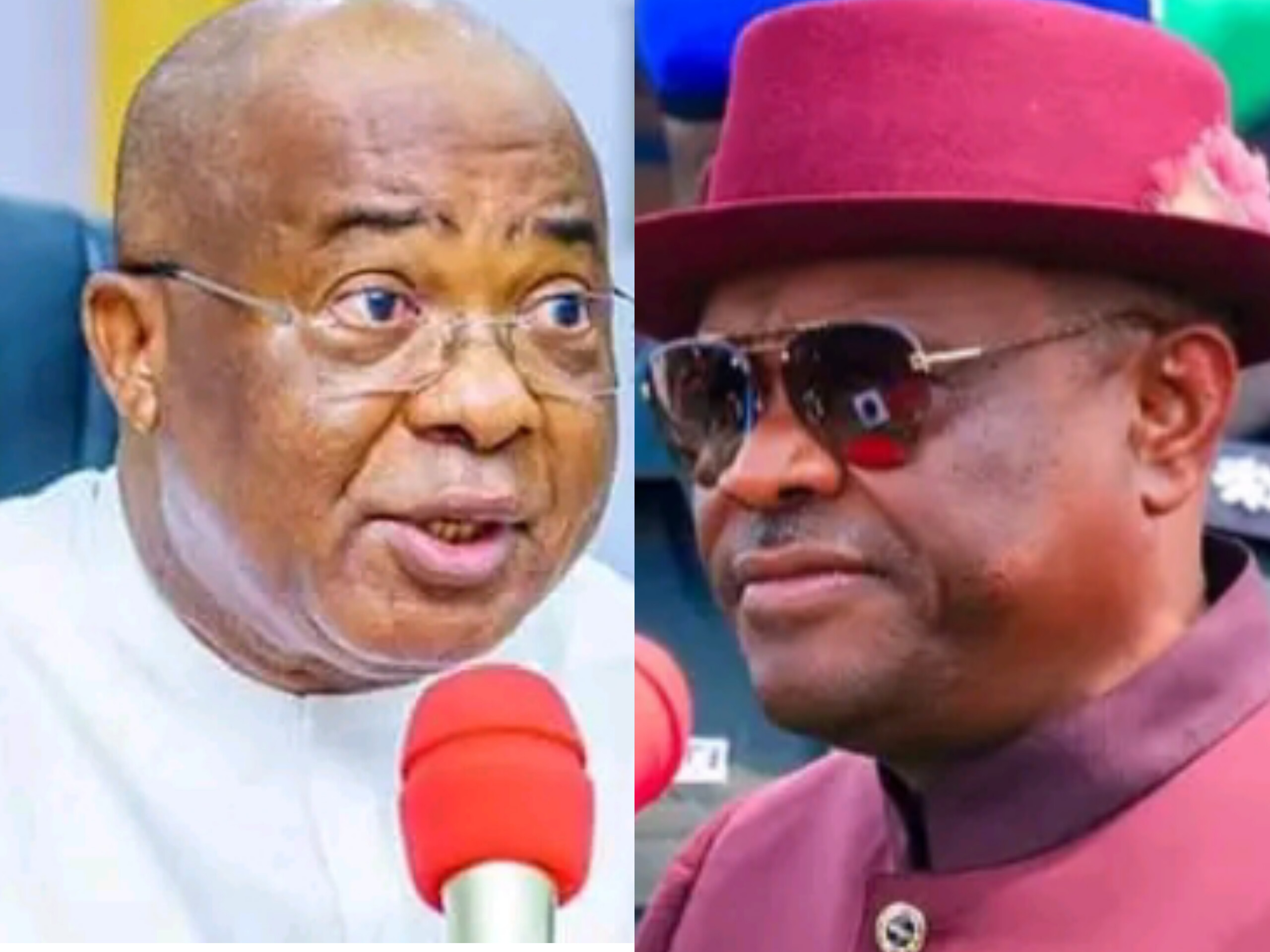
The Minister of the Federal Capital Territory (FCT), Nyesom Wike, has intensified his criticism of Imo State Governor and Chairman of the Progressive Governors Forum, Hope Uzodimma, over the political debate surrounding President Bola Tinubu’s 2027 re-election bid and the emerging Rainbow Coalition.
Wike questioned how the All Progressives Congress (APC) secured two senatorial seats in Imo State during the 2023 general elections when President Tinubu recorded less than 15 per cent of the presidential votes in the state.
According to Wike, the results demonstrated that Nigerian voters could make different choices in separate elections held on the same day.
“In Imo State, under Governor Hope Uzodimma, how did APC win two Senate seats in 2023, in an election held the same day as that of the President, when APC had less than 15 per cent in the presidential election? Was it a Rainbow Coalition? Were the voters confused?” Wike asked.
He made the argument while defending his support for Tinubu’s re-election while maintaining his involvement in the Peoples Democratic Party (PDP) and the Rainbow Coalition.
Wike’s position is that supporting President Tinubu at the presidential level does not necessarily mean supporting APC candidates in every other election. He cited similar voting patterns in Abia, Ebonyi and Enugu, where, according to him, voters supported candidates of different parties for various elective positions during the 2023 elections.
The FCT minister also questioned whether political leaders should interpret such voting patterns as evidence of voter confusion.
He argued that voters have the right to distinguish between presidential, senatorial, House of Representatives and state-level contests.
Wike further maintained that his support for Tinubu was never presented as an agreement to prevent the PDP from fielding candidates in the 2027 elections.
“I have said I will support the President and I am still supporting him. What has that got to do with my party?” Wike said, according to reports.
He explained that the Rainbow Coalition was designed as a broader political platform involving individuals from different political parties who support Tinubu’s presidential bid, rather than an APC structure.
The disagreement has placed Wike at odds with several APC governors, particularly Uzodimma, who has made it clear that APC governors intend to support the party’s candidates across the various levels of the 2027 elections.
At a meeting of APC governors in Abuja, Uzodimma said the governors would not support any political arrangement capable of undermining the APC, weakening the party or adversely affecting its candidates.
The governors stated that their campaign commitment would remain focused on APC candidates at all levels.
Wike, however, insisted that his political position was straightforward: he would mobilise support for Tinubu’s presidential re-election while retaining the freedom to support candidates of his choice in other contests.
He also criticised what he described as opposition from some APC governors to his appointment as FCT Minister, arguing that his political activities and relationship with President Tinubu had been transparent.
“There is nothing I have done that I have never told President Tinubu that this is what I intend to do,” Wike said.
He added that his appointment to the Federal Executive Council was made by Tinubu and that he would continue to operate according to the understanding he had with the President.
The former Rivers State governor also took aim at Kwara State Governor AbdulRahman AbdulRazaq, accusing him of spending too much time discussing Wike rather than concentrating on governance.
Wike alleged that the Kwara governor had replaced political office holders and candidates within the state and questioned the attention being given to his activities.
The minister also dismissed suggestions that he had joined the APC.
“I never told Mr President I will join APC,” Wike said, adding that if he eventually decided to join the ruling party, the decision would be his own.
The widening disagreement highlights a larger question ahead of the 2027 general elections: whether support for President Tinubu can operate independently of support for APC candidates in state and National Assembly contests.
For Wike, the 2023 results provide an example of voters separating their choices across different elections. For the APC governors, however, party cohesion and support for official APC candidates remain central to their campaign strategy.
The APC Governors Forum has consequently distanced itself from any political alliance that could undermine the party, while Wike continues to insist that his Rainbow Coalition is primarily focused on mobilising support for Tinubu’s presidential bid.
ALSO READ: Peter Obi Challenges Anambra Debt Claims: ‘Show Me the Evidence, I’ll Stop Campaigning’
As the 2027 political season approaches, the disagreement between Wike and the APC governors is likely to remain an important part of the wider debate over alliances, party loyalty, presidential support and the independence of voters in National Assembly and state elections.

