

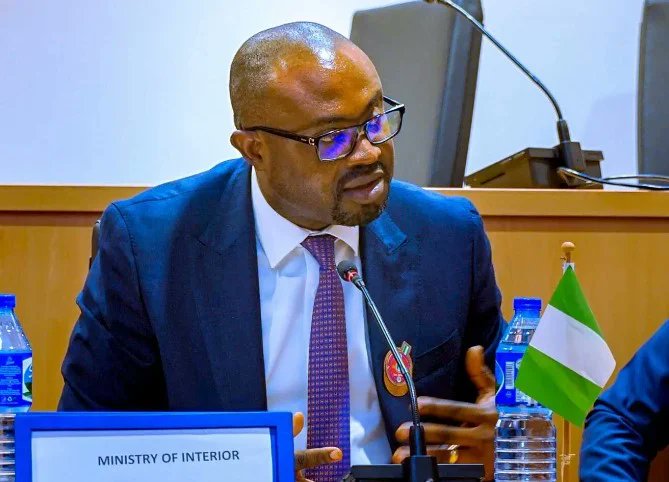
Nigeria’s Minister of Interior, Hon. Olubunmi Tunji-Ojo, has challenged comments attributed to former Vice President Atiku Abubakar regarding plans to reopen Nigeria’s land borders if elected President in 2027.
According to the Minister, Nigeria’s borders are not generally closed and therefore cannot simply be described as requiring reopening.
Tunji-Ojo, whose ministry supervises the Nigeria Immigration Service, the federal agency responsible for border and migration management, said recent developments show that several major land border posts across the country have already been reopened over the years.
Nigeria Reopened Major Land Borders
The Minister explained that the process of reopening Nigeria’s land borders began under the previous administration.
On December 16, 2020, the Federal Government reopened the Seme, Illela, Maigatari and Mfum border posts, while other crossings were subsequently restored to operations.
The Idiroko and Ikom borders were reopened for the movement of goods and services on April 20, 2022.
Under the current administration, the Kamba and Tsamiya border crossings in Kebbi State were also reopened in February 2026, strengthening cross-border connections with Niger Republic and Benin Republic respectively.
Tunji-Ojo maintained that these developments contradict suggestions that Nigeria’s land borders remain broadly shut.
Cameroon Border Closures Linked to Boko Haram Insurgency
Responding to references to borders involving Cameroon, Chad, Niger and Benin Republic, the Minister said it was important to distinguish between border closures caused by trade policies and those resulting from serious security concerns.
He explained that the prolonged closure of some border crossings between Nigeria and Cameroon, including Banki and Amchidé, was not connected to the 2019 border trade restrictions.
According to him, those locations were affected by Boko Haram insurgency as far back as 2014, when security threats forced the closure of the affected crossings.
The borders were later reopened in stages, beginning in 2019, while other important crossings, including Fotokol and Gambaru, resumed activities in 2021 following coordinated military operations and stabilisation efforts involving Nigeria, Cameroon, Niger and Chad.
The Minister argued that combining the security-related closures with Nigeria’s previous trade restrictions presents two separate historical developments as though they were one policy failure.
Security Concerns Still Affect Some Border Crossings
Tunji-Ojo acknowledged that not every border crossing in northern Nigeria currently operates without restrictions.
He said areas experiencing banditry, terrorism or residual insurgent activities may require tighter security controls.
According to him, such restrictions are deliberate security decisions designed to protect traders, travellers and communities living around the borders.
He stressed that reopening border routes without considering prevailing security conditions could expose residents and commercial operators to greater danger.
Modern Border Management Requires Balance
The Interior Minister said effective border management goes beyond choosing between complete closure and unrestricted movement.
He noted that modern border administration requires a combination of national security, proper documentation, immigration control, customs compliance and the facilitation of legitimate trade.
Tunji-Ojo therefore urged political leaders and stakeholders to avoid distorting recent developments for political advantage.
He said that political competition ahead of the 2027 general elections should not lead to the rewriting of Nigeria’s recent border management history.
The Minister added that if Atiku Abubakar intends to introduce a new border policy, the proposal should clearly explain how it would differ from the measures and systems already being implemented by the current administration.
He maintained that trade regulations, security-related border restrictions and infrastructure challenges should be treated as separate issues rather than presented as one continuous border closure policy.
The statement was issued by Hon. Olubunmi Tunji-Ojo, Minister of Interior, Federal Republic of Nigeria, on August 29, 2026.

