

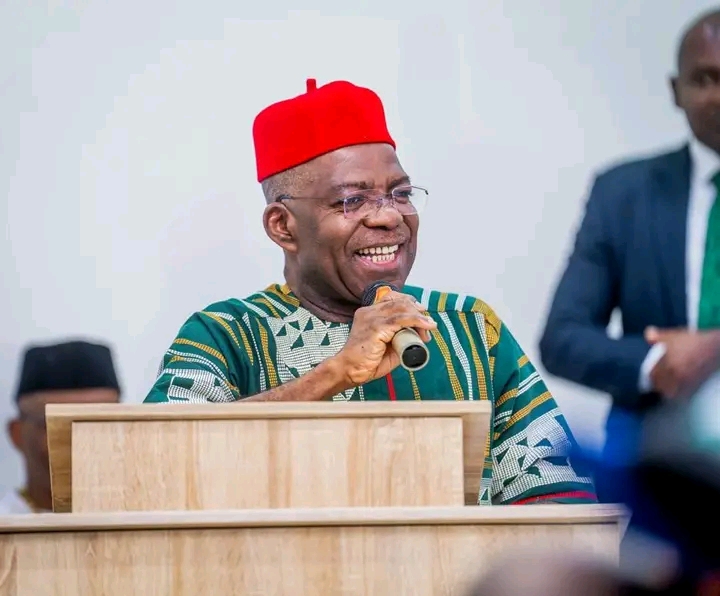
Abia State Governor, Dr. Alex Chioma Otti, OFR, has called on Ndigbo to move beyond the celebration of their historical achievements and focus on building strong, sustainable institutions capable of shaping the future of generations to come.
Governor Otti made the call on Tuesday, September 22, 2026, while serving as Special Guest of Honour at the public presentation of the book, Ohanaeze at 50: The Burden of Memory, The Politics of Relevance – A Critical Biographical Reflection of an Igbo Institution, authored by Agbaeze Ireke Kalu Onuma.
The 602-page book was unveiled at the Dover Hotel Event Hall, 14 Aromire Street, Ikeja, Lagos, attracting prominent political, traditional and business leaders.
Speaking on the theme, “Ohanaeze at 50: A Book That Holds Up The Mirror,” Governor Otti described the publication as more than a historical account of Ohanaeze Ndigbo. He said the book provides an opportunity to examine the issues of identity, leadership, responsibility, institutional relevance and the future of the Igbo people.
According to the governor, reaching a 50-year milestone should provide an opportunity for serious reflection rather than celebration alone.
“An institution cannot live indefinitely on the strength of its history. Heritage gives an organization legitimacy, but relevance must be earned continuously,” Otti said.
He noted that the book challenges Ndigbo to examine the present condition and future direction of Ohanaeze Ndigbo by asking fundamental questions about what the organisation has become, what it ought to become and the steps required to preserve its relevance.
Otti further argued that the future of the Igbo people cannot depend solely on their rich history and heritage. Instead, he said, sustainable progress requires institutions that can respond to the aspirations of young people, embrace technology and innovation, connect effectively with the global Igbo diaspora, and transform cultural identity into economic, intellectual and political strength.
The governor also reflected on the author’s use of the iroko tree as a metaphor for Ohanaeze, describing it as a symbol of deep roots, endurance and strength.
“Its roots may explain its strength, but its new branches and leaves determine whether it remains a living tree or not,” Otti stated.
He added that the central question should not simply be whether Ohanaeze has a glorious history, but whether that history can provide the foundation for a more impactful and consequential future.
Governor Otti consequently advocated the development of institutions capable of surviving individual personalities and changing political administrations. He described the book as both an examination of the past and a call for institutional renewal.
He commended Onuma for undertaking what he described as a courageous intellectual effort and recommended the publication to individuals interested in Igbo history, identity, unity, leadership and the future of Ndigbo.
Speaking earlier, the Chairman of the occasion, Elder U. K. Eke, MFR, former Group Managing Director of FBN Holdings Plc, stressed the importance of translating the ideas contained in the book into practical initiatives.
Eke said the publication presents a strong argument for reviewing the governance structures required to drive regional transformation. He also expressed confidence that Governor Otti and other governors in the South-East could play significant roles in advancing the region’s development.
The book reviewer, Prof. Okey Anueyiagu, also connected some of the publication’s themes to Governor Otti’s political journey, particularly his account of resilience and public service.
Recounting a conversation with Otti several years ago, Anueyiagu said the governor had expressed his determination to lead and serve his people despite the challenges associated with Nigerian politics.
Anueyiagu also recalled the uncertainty surrounding Otti’s earlier governorship bid, including the long wait for a court judgment. According to him, after receiving an unfavourable outcome, Otti told him, “I will come back.”
Anueyiagu said Otti eventually returned to the political contest and became governor, describing the experience as an example of resilience and determination.
He further recalled Otti’s statement that he was prepared to make personal sacrifices in the service of his people.
The reviewer also emphasised the importance of national unity, arguing that the broader responsibility of the Igbo people includes contributing to the growth and development of Nigeria.
In his response, the author, Agbaeze Ireke Kalu Onuma, said the book was written to stimulate reading, discussion and action rather than simply serve as a decorative publication.
Onuma praised Governor Otti’s transition from the private sector into public service, saying his experience demonstrated that professionals from outside traditional politics could contribute positively to governance.
He expressed optimism about Abia State’s future and said he believed the state could achieve greater developmental milestones.
The event reached its climax with the formal unveiling of the book by Governor Otti.
The foreword to the publication was written by Elder Dr. Uma O. Eleazu, OON, who was also present at the event.
Among the notable personalities in attendance were former Anambra State Governor, Peter Obi; Senator Enyinnaya Abaribe; the Obi of Onitsha, HRM Nnaemeka Alfred Achebe, CFR, mni; and the Enachioken of Abiriba, HRM Eze Kalu Ogbu IV, alongside other dignitaries.
The presentation provided an opportunity to reflect on the 50-year journey of Ohanaeze Ndigbo while highlighting broader questions about institutional leadership, generational renewal, cultural identity and the future development of the South-East.
ALSO READ: VIDEO: Governor Mbah Inspects Near-Complete Ohanaeze Ndigbo Headquarters in Enugu
Source: Chief Press Secretary to the Executive Governor of Abia State, Ctz. Ukoha Njoku Ukoha, September 23, 2026.


[…] Gov. Otti Urges Ndigbo to Move Beyond History, Build Strong Institutions for the Future […]