

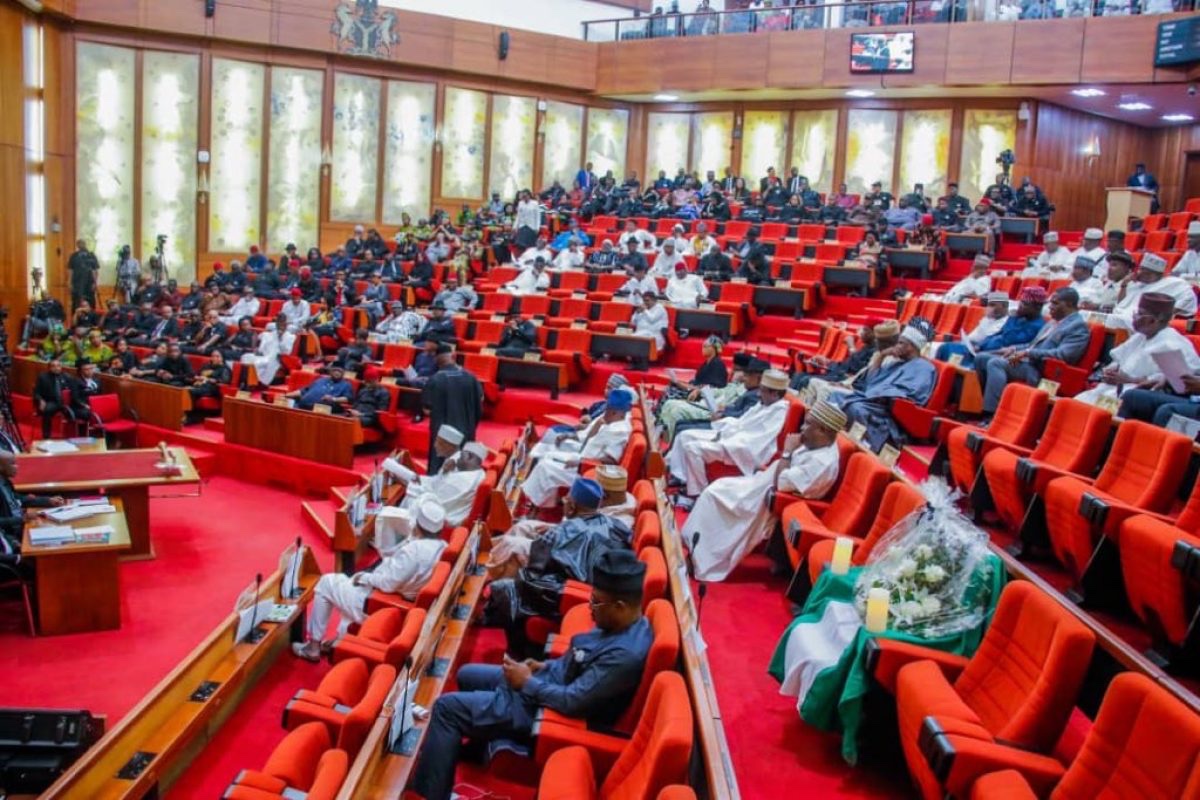
The Nigerian Senate has clarified why the Federal Capital Territory (FCT) is not included in the proposed constitutional framework for the establishment of state police across the country.
According to the Senate, the exclusion is deliberate and is linked to the FCT’s unique constitutional and administrative structure. Unlike Nigeria’s 36 states, the Federal Capital Territory does not have an elected governor or a State House of Assembly and is administered directly by the Federal Government.
The explanation was given by the Chairman of the Senate Committee on Media and Publicity, Senator Yemi Adaramodu, on Friday while responding to questions from journalists regarding the proposed state police arrangement.
Adaramodu said the administrative structure of the FCT makes it fundamentally different from the states that would be permitted to establish their own police forces under the proposed constitutional amendments.
He explained that the territory is administered by a minister appointed by the President, who operates within the framework of the Federal Executive Council (FEC). Legislative responsibilities for the FCT, he added, are handled by the National Assembly.
“The FCT issue is different. It is under the Federal Government,” Adaramodu explained.
The senator noted that the absence of a governor and an elected legislative assembly means the FCT does not have the same institutional framework contemplated for states under the proposed state police system.
He stressed that because the territory derives its administrative authority directly from the Federal Government, policing responsibilities within the FCT would continue to fall under the federal policing structure.
State Police Reform Moves Forward
The Senate’s clarification comes as the Federal Government and the National Assembly intensify efforts to introduce a decentralised policing system in Nigeria.
For years, stakeholders have advocated the creation of state police as a way of improving grassroots security, strengthening local intelligence gathering and allowing security agencies to respond more effectively to threats within individual communities.
The proposed reforms are expected to involve both constitutional amendments and new legislation designed to establish the legal and operational framework for state-controlled police forces.
The Presidency has also indicated that President Bola Ahmed Tinubu is expected to receive the draft Executive National Policing Bill on September 3.
The disclosure was made by the President’s Chief of Staff and Chairman of the Presidential Working Group on the National Policing Bill, Femi Gbajabiamila, after a meeting of the group at the Presidential Villa in Abuja.
Gbajabiamila also announced plans for a public information portal that would allow Nigerians to submit memoranda and position papers as part of the consultation process before the proposed bill is transmitted to the National Assembly.
States to Have Legislative Oversight
Under the proposed constitutional amendments, State Houses of Assembly would have powers to legislate on the establishment, organisation, administration, funding and oversight of state police forces.
The proposed framework would therefore give state governments significant responsibility for the management and financing of their respective police formations.
While states would bear the primary financial responsibility, the Federal Government could provide grants or other forms of assistance where necessary.
A proposed Section 216A provides for federal grants or assistance to state police based on recommendations from the National Police Council, subject to approval by the National Assembly.
However, the proposal does not currently establish a fixed federal funding formula, minimum federal contribution or guaranteed revenue allocation for state police.
National Police Council to Coordinate System
The National Police Council is expected to play an important role in coordinating the relationship between federal and state policing authorities under the proposed arrangement.
The council, chaired by the President and comprising key federal and state officials, would provide an avenue for coordination between the different levels of government.
The proposed structure is intended to ensure that the creation of state police does not completely disconnect state-level security operations from the broader national policing system.
Why the FCT Will Remain Under Federal Police
Despite the proposed shift towards decentralised policing, Adaramodu maintained that the FCT would remain outside the state police structure because of its distinct constitutional status.
Unlike the states, the FCT does not have an elected governor or a State House of Assembly. Its administration is conducted through the Federal Government, while the National Assembly performs legislative functions for the territory.
Consequently, the senator said the FCT does not possess the constitutional institutions required to establish and oversee a state police force under the proposed framework.
For the time being, policing in the nation’s capital is therefore expected to remain under the Nigeria Police Force and other federal security structures.
Further constitutional and legislative processes are expected as the government and lawmakers work to finalise the proposed policing reforms.
ALSO READ: Tinubu Unveils Historic Plan to List NNPCL on Nigerian Stock Exchange
The outcome of those processes could significantly reshape Nigeria’s security architecture by giving states greater responsibility for policing while retaining federal oversight and coordination at the national level.

